Project 04 / 04 · Networking · C++ · University
Peer-to-peer file sharing over UDP
A C++ tool that shares files between computers on a local network over UDP, adding its own packets, sequence numbers and checksums.
- C++
- UDP sockets
- Checksums
- Linux
(01) Why I built it
Why I built it
UDP is fast but makes no promises: packets can be lost, duplicated or arrive out of order. The Computer Networks project at FAST asked us to move files across a deliberately unreliable channel and build the reliability ourselves, close to how TCP does it, with a client, a server and test code designed to break other teams' work.
(02) How it works
How it works
- 01
Cutting the file into packets
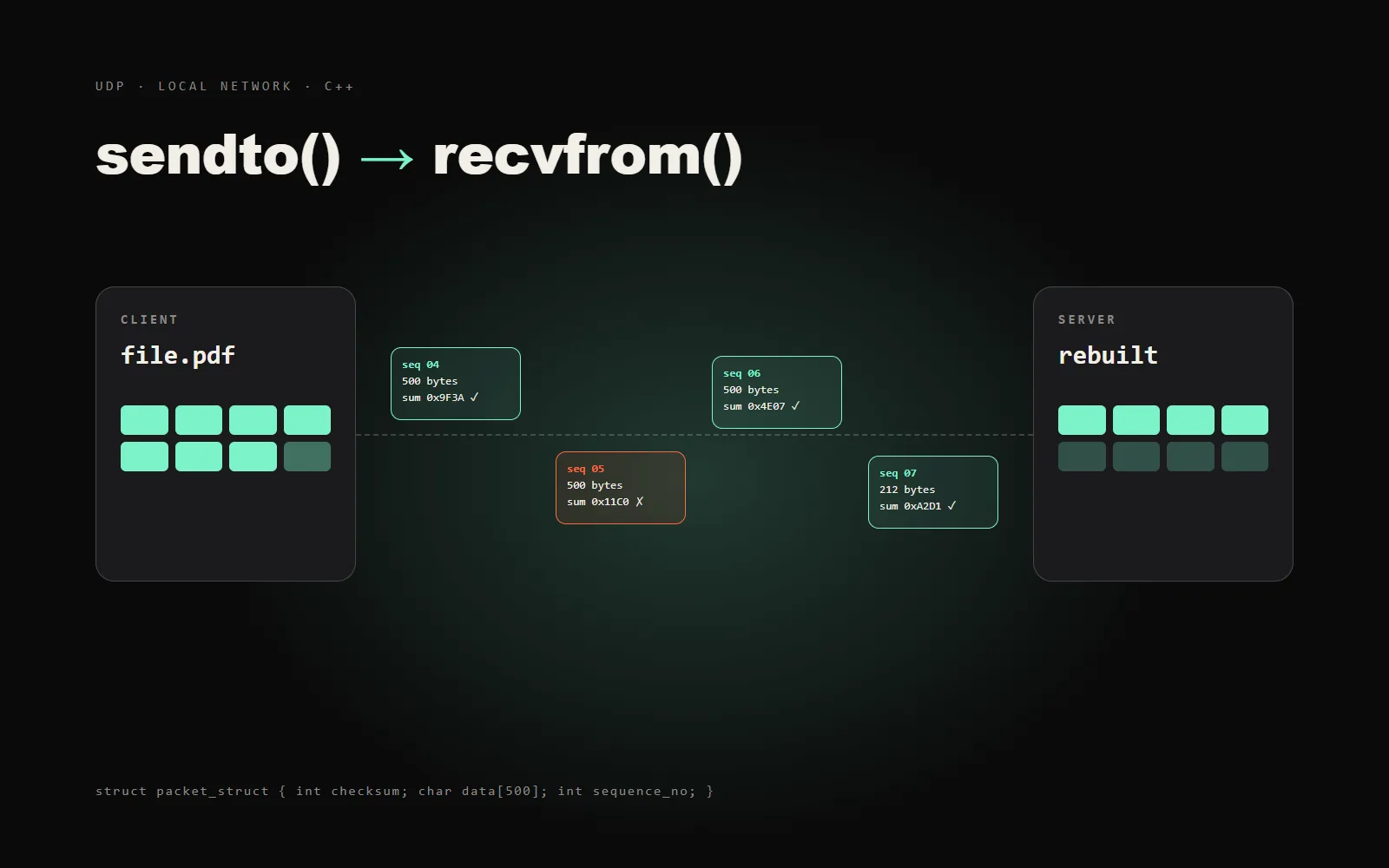
The sender reads the file and splits it into 500-byte packets. Each packet carries its data, a sequence number and a checksum.
- 02
Checking every packet
Each packet gets a 16-bit ones'-complement checksum, the same kind used in IP and UDP headers. The receiver recomputes it on arrival, so a damaged packet is caught before it goes into the file.
- 03
Putting it back together
The receiver uses the sequence numbers to rebuild the file in order and replies to the sender over the same socket.
- 04
Designed for a hostile network
The brief went further: sliding windows, acknowledgements and timeouts, retransmission, CRC-16 error detection, many clients at once with POSIX threads, and configuration files that drop or corrupt packets on purpose to prove the design holds up.
Stack · C++ · POSIX sockets · UDP · Linux
(03) From the source
From the source
The packet and the checksum, from the original source
struct packet_struct {
  int  checksum;
  char data[500];
  int  sequence_no;
};

uint16_t checksum(void *buffer, size_t len) {
  const uint16_t *buff = (uint16_t *) buffer;
  uint32_t sum = 0;
  while (len > 1) {
    sum += *buff++;
    if (sum & 0x80000000) sum = (sum & 0xFFFF) + (sum >> 16);
    len -= 2;
  }
  if (len & 1) sum += *((uint8_t *) buff);
  while (sum >> 16) sum = (sum & 0xFFFF) + (sum >> 16);
  return (uint16_t) ~sum;
}
What it taught me
What it taught me
Writing reliability by hand is the fastest way to understand why TCP looks the way it does. Every header field I take for granted now is there because someone once lost a packet.
Next project
HQ, an AI virtual office